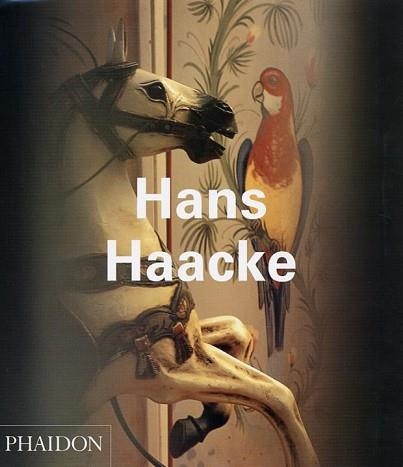
Born in Cologne in 1936 and based in New York since 1965, Haacke's strong politi
cal, cultural and social concerns are reflected in his installations, texts and
sculptures. Throughout his 50-year career Haacke has frequently changed the pres
entation of his art to get his message across. Often borrowing from non-art sour
ces such as corporate advertising, questionnaires or scientific experimentation,
Haacke is probably the most successful and best-known late twentieth century ar
tist to create political art that manages to hit its mark with such concision an
d elegance.
Haacke sometimes works like a sleuth, uncovering the art world's
hidden politics and economics. This practice has famously led to museum official
s cancelling his exhibitions. His 1971 solo show at the Solomon R Guggenheim Mus
eum, New York, for example, was cancelled in response to his proposal to present
the questionable real estate dealings of several New York companies.
Haacke
is a unique figure in post-war art, and his work has touched on such diverse mov
ements as Conceptual, Pop, Minimal and Land art. Highly respected as a writer an
d thinker, his integrity as well as the formal innovations of his art have prove
n hugely influential for many generations of contemporary artists via exhibition
s at such museums as the Tate Gallery, London (1984), the New Museum of Contempo
rary Art, New York (1986), and the Centre Pompidou, Paris (1989).
German art
historian Walter Grasskamp surveys the artist's career with an emphasis on the i
nnovations he has brought to the notion of public art. In the Interview, America
n art historian Molly Nesbit discusses with the artist his working practices and
his sometimes turbulent relationship with the art world.
London-based critic
Jon Bird focuses on Mixed Messages, Haacke's presentation of works from the col
lection of London's Victoria and Albert Museum and Serpentine Gallery. The Artis
t's Choice, excerpts from Writing the Truth: Five Difficulties by Bertolt Brecht
, reflects Haacke's approach to his own work. The Artist's Writings include an e
xcerpt from Free Exchange (1995), his book-length conversation with Pierre Bourd
ieu, and an essay on his controversial project for the Reichstag in Berlin (1999
-2000).