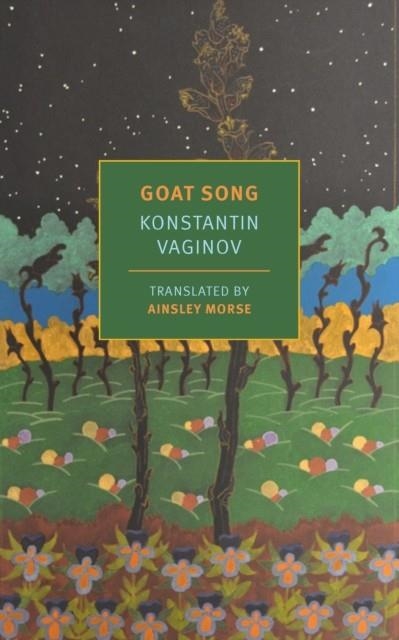
Two novels by one of the Soviet Union's most inventive writers, written in the tradition of Gogol and Dostoyevsky but with a 20thcentury, modernist edge.Konstantin Vaginov was an early and exemplary figure of Soviet modernist writing, in all its agonized and glorious contradictions. Born into an educated middleclass family at the turn of the century, Vaginov came of age with the Bolshevik revolution. His novels of the late 1920searly 1930s are daringly experimental and tragically nostalgic, mourning the irrevocable loss of prerevolutionary intellectual culture with mercilessly ironic prose. Hopelessly adrift in the brave new Soviet world, Vaginovs protagonists attempt to conjure the recent and distant past by stockpiling old books and songs, vulgar baubles and bad jokes, newspaper clippings, coins, and graffiti.The first novels title, Goat Song (1928), is an ironically literal translation of the Greek word tragedy (tragodiagoat song). The novel features thinly veiled portraits of Vaginovs contemporaries, the luminaries and leftovers of the onceflourishing PetersburgPetrogradLeningrad arts community, as they flounder and selfdestruct in their new bracingly materialist circumstances. Echoing Gogol, Dostoyevsky and Bely, Goat Song is both a classic Petersburg city text and its swan song: Now there is no Petersburg. There is Leningrad but Leningrad has nothing to do with usthe author is a coffinmaker by trade, not a cradle expert. Works and Days of Wistlin (1930) follows a nonchalant novelist as he unscrupulously mines the lives of his friends and fellow citizens for literary material. Like the fleamarket trinkets hunted by Goat Songs marginal figures, Wistlins eccentric and frivolous victims are yesterdays relics and nobodys concern. His exploitation of human material is a wry commentary on the concurrent efforts to industrialize and collectivize the Soviet economy, at horrific human cost.This volume will be followed by Vaginovs exquisitely bleak final two novels, Bambociatta(1932) and Harpagoniana (1934).